[This was written early 2022. At that time, I was still a Christian on the brink of losing it all. I was still trying to hold on to my faith. This piece is a signficant part of my journey. My honest search of truth eventually drew me away from the Christian religion later that year]
Introduction
This 2-part blog post is a result of wrestling through the most painful and difficult season of my life. Through this season, I realized I was afraid of being honest because of what it might cost me. So this blog post is me needing to be honest in order to move forward.
Over the years, “Lyn as the passionate Bible guy” has become a rather central part of my identity to many and I have lived out this passion rather publicly. And it’s been a joy to live this passion; I do love the Bible. But currently, I find myself in a season of what feel like rather large changes in worldview and potential life direction are happening, and I am not quite sure what implications my honest conclusions about the Bible will have on these things. All I know is I have been afraid of being honest up until now, and so I write this blog to move forward.
Part I is intellectual. It’s a case study in the way that over the years, as I’ve studied the Bible more, I have slowly realized that the Bible does not hold up to the scrutiny I was told it would. The Bible is best explained as containing historical inaccuracies, legitimate contradictions and failed prophecy. I use Daniel as a case study for this conclusion.
Part II is focused on the heart. I end with where I am currently in life and my uncertainly about what the future holds in regards to the Bible and therefore what shape my walk of faith will take. For a while I have felt a low-level fear to be intellectually honest, and it’s been rather unhealthy for me. So this is me trying to move forward more honestly and hopefully more healthily.
I write this blog with a deep awareness of the cost that shifting conclusions about the Bible have within a Christian environment. I know there’s the potential that people will feel betrayed by me. The charge of being a “danger to the community” or a “false teacher” or “prideful individual that God will judge” are all labels that haunt me as I’ve tried to honestly navigate the world and the Bible, which is why the Bible has become so painful.
So here is Part I. If you are not interested in the intellectual study of the Book of Daniel, I would encourage you just to skip to the conclusion of Part I titled The Camel’s Back is Broken, and then continue into Part II: Getting Personal: The Writing on the Wall.
There are a hefty amount of footnotes at the bottom of the blog for all those interested. Also, as always, feel free to engage with the intellectual part. I am open to new evidence.
Part 1: How I Became Convinced Daniel is a 2nd Century Forgery with Failed Prophecy.
The Book of Daniel stands as perhaps the key book in the debate about the reliability and authority of the Bible since it predicts accurately multiple events in history including the emergence of specific kings and the rise and fall of empires.
Since the Traditionalist View says the Book of Daniel was written by Daniel in the 6th century in Babylon, Daniel’s accuracy in his predictions serves as proof of the Bible’s inspiration and authority. “The Bible predicts the future accurately!” they resound!
But on the other hand, the Critical View says the Book of Daniel wasn’t written by Daniel in the 6th century, but by Jews in the 2nd century during the intense persecution againt Judaism at the hands of the Greek Seleucid king Antiochus IV in 167-164 BCE. These Jews falsely believed that their moment in history (the 2nd century) was the “the end time” and thus they wrote Daniel as a way of recording past history in the guise of true prophecy to point to their time. They then attributed it to Daniel in the 6th century to give it legitimacy. This view was first articulated by the Neo-Platonist philosopher Porphyry as far back as the 3rd century AD. Even the ancients recognized Daniel was a forgery.
In short, throughout my years of study, I really wanted the Traditionalist View to be true. I really did. But as I was honest with the text, I couldn’t personally believe it anymore because it didn’t stand up to scrutiny. The Critical View really made the most sense of the Book of Daniel. The implications of this are that Daniel is a deceptive forgery containing failed predictive prophecy—failed prophecies that later became a bedrock for the Christian church. So, pretty big implications.
This is my journey. I will present each point as a series of three “straws” that eventually “broke the camel’s back” so to speak. Each “straw” alone isn’t particularly persuasive, but it’s when they are seen together that the weight became overbearing for me and I had to succumb to the evidence.
Straw One: Daniel the uniquely “Secret and Sealed Book”
Daniel is given a unique command by an angel at the end of the book.
“But you, Daniel, keep these words secret and the book sealed until the time of the end…Go your way, Daniel, for the words are to remain secret and sealed until the time of the end” (Dan 12:4, 9)
This type of command was never given to any other prophet. Jeremiah was never commanded to seal his prophecies. Ezekiel was never told to keep his words secret. These prophets proclaimed them publicly. But Daniel was told to write down his visions (not proclaim them) and keep them secret “until the time of the end”
Why?
I started to realize however that a 2nd century date for Daniel offers a perfect explanation of this verse. If the visions of Daniel (ch 7-12) were written in the 2nd century, this actually is exactly the type of command we’d expect to find in a forgery. If prior to the 2nd century no one knew anything about the visions of Daniel, which seems assumed by this verse (Footnote: Sealed Book), the authors of Daniel knew they needed to give an explanation for this sudden appearance of these previously-unknown visions. So these 2nd century authors said an angel told Daniel to intentionally seal the visions and keep them a secret until the time of ‘the end.” This “time of the end” was the 2nd century BCE, therefore, it was conveniently time to “unseal” the visions that they claimed had always existed, but just previously kept secret.
Of course, this command alone wasn’t enough to convince me Daniel was a 2nd century forgery, but I had to be honest that it was exactly the type of command we’d expect to see if Daniel was a forgery. But this “Straw” on its own was not sufficient to convince me, so let’s turn to another “Straw” in my journey.
Straw Two: Historical ‘Difficulties’ with the Babylonian and Persian Periods
Both sides of the debate (Traditional and Critical) recognize that there are a number of historical difficulties within the first half of the book of Daniel. The Traditional View formulates explanations to deal with these historical difficulties while the Critical View simply says the Jewish author got his 6th century history confused since he was writing in the 2nd century.
I want to stay upfront that I am not a Danielic expert with a PhD in ancient Babylonian and Persian history (and neither is anyone reading this blog I imagine). We are all non-experts doing the best we can. However, with that said, I am basing these points off of the work of actual scholars in conjunction with my own reading of the Bible and basic knowledge of history. Even non-experts need to make some conclusions as best they can at some point. But I am open to changing my mind.
Here are some of the biggest historical difficulties.
1) Did the siege of Jerusalem in 606 BCE even happen?
Daniel 1:1-2 says Nebuchadnezzar besieged Jerusalem and carried off Temple vessels to Babylon in 606 BCE (the third year of King Jehoiakim). The description of this event is just difficult to coincide with what we know about this period. It really just doesn’t seem to fit the timeline in the Bible. If you want more extensive details, you can skip to the bottom of this blog (Footnote: Siege).
While it is always possible that a siege like this happened in 606 BCE, the question all evidence asks of history isn’t is it possible but is it probable? What actually does seem probable is that a 606 BCE siege was the invention of the author made for theological reasons (Footnote: 70 Years).
2) Difficulties with King Belshazzar. Daniel says Belshazzar was Nebuchadnezzar’s son and succeeded him as king (Daniel 5, Dan 7:1 and 8:1). The problem with this is that Belshazzar was not Nebuchadnezzar’s son, he was Nabonidus’ son (no biological relationship to Nebuchadnezzar). Also, Belshazzar was never actually king of Babylon but served only occasionally as regent when his father Nabonidus was absent from Babylon in 553-542 BCE (not in 539 BCE when Babylon fell). Conservative scholars have made defenses of this difficulty (Footnote: Belshazzar).
3) Difficulties with “Darius the Mede.” Put bluntly, there is no historical evidence inside or outside the Bible (apart from Daniel of course) that a figure named “Darius the Mede” ever existed. This “Darius the Mede” is described as taking over “the realm of the Chaldeans” (9:1) after the Babylonian ‘king’ Belshazzar was killed (5:30-31). But it was the Persian King Cyrus the Great who did these things, not “Darius the Mede.” Now, a lack of any external evidence doesn’t mean he didn’t exist, it’s just a glaring hole in history for a figure who was supposedly as powerful as this “Darius the Mede” (powerful enough to single-handedly write a law into effect that demanded all subjects pray to him alone, not Cyrus! Dan 6:6-11, 25-27). Conservative scholars have provided some theories to explain how “Darius the Mede” is a real figure in history, but actually, seeing “Darius the Mede” as a literacy creation by the authors of Daniel makes a lot of sense of the theological needs of the book (Footnote: Darius the Mede).
4) The presence of Greek loan words. Finally, in Daniel 3:3-12, the Aramaic of the narrative oddly uses Greek loan words to describe three instruments: the lyre (Gr. kitharos), the harp (Gr. psalterion) and drum (Gr. sumphonia). While I suppose it’s possible that Daniel (writing in 6th century Babylon) used Greek instrument names instead of their Babylonian names, this scenario isn’t really probable. However, on the flip-side, it actually becomes very probable he did this if the author lived the 2nd century Greek period.
In Conclusion: So, these are some of the main historical difficulties found in Daniel. Again, Christian scholars have given explanations to these difficulties. But the question isn’t are there explanations? but do these explanations provided explain the evidence in the best way? For some, they are. However, for me, the explanations provided by the Critical View were becoming much more convincing in adequately explaining what I was seeing in the text alongside history.
Yet amidst these historical difficulties, I still remained optimistic about Daniel. However that changed with “Straw Three” and it was this “straw” that broke the camel’s back for me.
Straw Three: All of the Visions in Daniel Climax in the same time — the 2nd Century.
This was the final straw that broke the “traditionalist camel’s back” for me. The evidence was all pointing to this one conclusion: all the visions of Daniel (not just some, but all) predicted history leading up to the 2nd century BCE and not beyond. This meant that none of the visions pointed to the time of Rome, Jesus or to a future ‘End-Time.’ The unavoidable conclusion was that Daniel simply expected a slew of things in the 2nd century BCE that just didn’t happen: the kingdom of God didn’t come; the Son of Man wasn’t vindicated and the resurrection of the dead didn’t happen. These predictions simply failed.
The consistency by which Daniel’s predictions all pointed to the 2nd century and the consistency by which the climax of these predictions also failed to come about was overwhelming proof to me that the book was written in the 2nd century as a forgery, not by a 6th century visionary who was accurately predicting the future.
Let me explain.
Anyone who reads Daniel knows it contains five different visions.
Chapter 2 Vision: Nebuchadnezzar’s Statue.
Chapter 7 Vision: The Four Beasts and the Son of Man.
Chapter 8 Vision: The Goat and the Ram.
Chapter 9 Prayer: The 70 weeks.
Chapter 10-12 Vision: The Warring North and South.
All these visions look at history leading to a climactic end. In Bible school, I was taught that while all these visions talk about an end, they all talk about different ends (which yes, is as awkward a conclusion as it sounds). I was taught that while some visions end in the 2nd century (ch 8), others end at Rome (ch 2, 7) and still others point to an even further ‘End-Times’ (ch 10-12). But this always seemed to me like an unnatural conclusion forced on the text, but I realized I had to embrace it because it was what I needed for my theology to work; I needed Daniel to predict Jesus and Rome. If it didn’t, my theology had problems.
But needing a conclusion to be true for the sake of my worldview over time really started to destroy my intellectual honesty, and my worldview was cracking because reality wasn’t fitting what I needed to be true. But more on that later.
Interestingly enough, once I put aside what I needed to be true, the book of Daniel became surprisingly clear and simple! This clarity was a breath of fresh air. I had always believed Daniel was inherently complicated, so I was stunned by how it all became so simple once I didn’t force Daniel to meet my needs.
So, let’s look at each vision in part. For the faint of heart, you can skip to my conclusion: The Camel’s Back is Broken below.
Chapter 8: the Vision of the Ram and the Goat.
This vision is where I will start for one logical reason: the vision is clearly interpreted for us by an angel.
The vision explicitly says it’s describing “the time of the end” (8:17, 19). So, when was the end-time? It wasn’t Rome, Jesus or the Second Coming. Nope. It was clearly stated as being during the Greek period (8:21), climaxing with a “Little horn” who is none other than the Seleucid king Antiochus IV who persecuted the Jews in the 160s BCE. This interpretation is wildly uncontroversial, even among conservative scholars.
Therefore, my starting point in my journey was simply recognizing that the chapter 8 vision explicitly told its readers when “the time of the end” would be – not Rome, not Jesus and not the Second Coming. The “time of the end” was during the 160s BCE.
But the question remained: do the other visions in Daniel have different ends or the same end (the 160s BCE? Let’s see.
Chapter 2: Nebuchadnezzar’s Statue
Nebuchadnezzar’s dream of a statute (2:31-35) is famous for “predicting” successive world powers represented by descending metals on the statue (gold, silver, bronze, iron, iron/clay). This statue ends with feet of iron/clay at which time “a stone cut out, not by human hands” will smash the feet of the statue, thus destroying it and “becoming a great mountain that fills the whole earth” (2:35). This stone is the kingdom of God (2:44), and Daniel predicts it will be established during the kingdom of the feet of mixed iron and clay. But what do these iron/clay feet represent at which time kingdom will come?
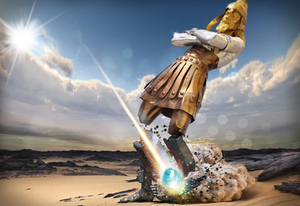
While various options have been suggested for these iron/clay feet (the Roman Empire, the Divided Roman Empire, the various European kingdoms, a future Anti-Christ Kingdom), Daniel actually gives us a big clue as to who the feet represent.
Daniel says:
“The feet and toes shall be a divided kingdom.…As you saw the iron mixed with clay, so will they mix with one another in marriage but will not hold together as iron does not mix with clay. And in the days of those kings the God of heaven will set up a kingdom that will never be destroyed.” Daniel 2:41-44
The feet are not Rome. They are not Europe. Daniel actually gives us the answer (!) later in chapter 11 when he describes how the Seleucid and Ptolemaic Kingdoms (3rd-2nd centuries) sought to foster diplomacy through political marriages which ultimately failed (see 11:6, with Berenice & Antiochus II, and 11:17 with Cleopatra I Syra & Ptolemy V).
Here we have an actual answer (!) in Daniel 11 which perfectly fits the description of the mixed clary/iron feet in 2:43. I couldn’t ignore this connection. Once I got rid of my needs (the feet needed to be Rome) and just let Daniel interpret Daniel (a good interpretive method), the conclusion was unavoidable: the feet are the Diadochi kingdoms that splintered off after Alexander the Great’s “iron kingdom,” specifically focusing on the Seleucid and Ptolemaic kingdoms described in chapter 11 (Footnote: Nebuchadnezzar’s Statue).
Good interpretive methods had brought me to the clearest conclusion. Not only had I moved from a clearer vision (ch 8) to a less clear one (ch 2) and found they both pointed to the same end (2nd century BCE), but I had used Daniel (ch 11) to interpret Daniel (ch 2). It seemed to me I came to this conclusion through the sound interpretive methods. However these methods were leading me to an undesired conclusion that didn’t fit my needs.
But I felt compelled to conclude that for the chapter 2 vision: the kingdom of God was predicted as coming during the Seleucid-Ptolemaic Period (2nd century). But this prediction simply just didn’t happen.
On to the next vision:
Chapter 7: The “arrogant little horn” and the Son of Man.
This vision is similar to chapter 8 (our clearest vision) in that it ends with the arrogant “Little Horn” (Dan 7:8c, 11) being destroyed. Initially, a vision having similarities to chapter 8 should comfort us. We should feel hope when we see that chapter 7 describes an arrogant “Little Horn” just like the arrogant “Little Horn” of chapter 8 (8:11) since we already know that the “Little Horn” of chapter 8 is Antiochus IV. It is therefore logical to see the “Little Horn” of chapter 7 as Antiochus IV and Daniel predicting “the Son of Man” as coming during the 160s BCE.
Once this connection with Antiochus IV is made, we realize the description of the “Little Horn” in chapter 7 fits surprisingly well with what we know Antiochus IV did in history (7:20-21 and 7:25), even describing how the “Little Horn” would defile the sanctuary for 3½ years (7:25), just as Antiochus defiled the temple for the same length of time (167-164 BC) (1 Macc 1:29-4:52). All evidence suggests “the Little Horn” is Antiochus IV.
This conclusion was the most logical and most natural conclusion in my mind, and it brought a high degree clarity to the text. However, my theological needs took what was a clear conclusion and made it complicated because I needed Daniel 7 to be talking about Rome, not the Seleucid Period and Antiochus IV. After all, in my theology, the “One like a Son of Man” is Jesus, and Jesus didn’t come in the 2nd century BCE.
But all the while I was coming to terms with the evidence that said chapter 2 had predicted that the Kingdom of God would come in the Seleucid-Ptolemaic Period (2nd century BCE), but this just didn’t happen. Could it be the same for chapter 7? Perhaps Daniel did predict the coming of “One like a Son of Man” in the 160s as well, but just like his chapter 2 prediction, this also just didn’t happen.
I was still hesitant. But then there was one moment I couldn’t resist this conclusion. I remember one night of reading, I discovered something that blew my mind: the 10 horns of the Fourth Beast Dan 7:7-8 fit the Seleucid dynasty leading up to Antiochus IV perfectly! If we start from Alexander the Great, there are 10 literal kings leading up to Antiochus, and (here’s the mind-blowing part) 3 of those kings in line for the throne (before Antiochus) were either assassinated or taken way (“plucked up”), making way for Antiochus to ascend the throne. It fit the 10-horn scheme perfectly and I couldn’t believe it!
- Horn 1. Alexander the Great
- Horn 2. Seleucus I Nicator (305-281)
- Horn 3. Antiochus I Soter (281-261)
- Horn 4. Antiochus II Theos (261-246)
- Horn 5. Seleucus II Callinicus (246-225)
- Horn 6. Seleucus III Soter (225-223)
- Horn 7. Antiochus III the Great (223-187)
- Horn 8. Seleucus IV (187-175) (“plucked up horn” #1 – assassinated)
- Horn 9: Demetrius I (“plucked up horn #2 – sent to Rome as political hostage)
- Horn 10. Antiochus (“plucked up horn” #3 – assassinated)
- Little Horn: Antiochus IV Epiphanes (175-163)
I was astounded when I saw this! I had often been told in classes that the 10 horns were either symbolic or Roman Emperors (but the Roman Emperor scheme still had problems and didn’t fit as well as this Seleucid scheme did). However, once I saw the horns fit the Seleucid dynasty perfectly, I literally sat there dumbstruck thinking “how did no one ever tell me this?” I was amazed. Could Daniel really be this clear? You mean it didn’t have to be confusing? Three plucked-up horns could literally be three Seleucid royals either assassinated or deported making way for Antiochus to take the throne?! (Footnote: Plucked-Up Horns)
Once I saw this evidence presented to me, I was sold: the Fourth Best of Daniel 7 was the Seleucid Kingdom (not Rome) and the Little Horn was Antiochus IV (Footnote: Chapter 7 Vision). And just like the vision in chapter 2 expected the kingdom of God in the 2nd century, but it didn’t come, so too, chapter 7 expected “One like a Son of Man” to come in the 160s BCE, but this, too, didn’t happen.
There was appearing before me a consistency in failed predictive prophecy that was harder and harder to ignore.
Chapter 9: The Prayer and the 70 Weeks (Dan 9:24-27)
Chapter 9 isn’t technically a vision but an answer to prayer. The 70-weeks prediction is wildly complicated, so I won’t go into much detail. All I want to say here is once I realized chapter 8, 2 and 7 all climaxed in the 160s BCE, and made predictions that just didn’t come to pass, admitting that “final week” (final 7 years) of Daniel’s 70 weeks (9:24-27) were the 7 years of 171-164 BCE became a no-brainer. Again, 171-164 BCE fits the description and timeline of the final week perfectly, but it’s only because the most natural interpretation doesn’t fit with what Christian theology needs to be true that we don’t embrace wholeheartedly what appears to be the best interpretation.
The final week (9:26-27) starts in 171 BCE with the assassination of the High Priest Onias III (the “anointed one cut off”) and then continues into Antiochus IV’s deceitful covenant with the Jews (1 Macc 1:30), finally ending in 164 BCE after the desolation of the sanctuary for 3½ years (167-164 BCE; see 1 Macc 1:29-40, 54). (Footnote: 70-Weeks)
Therefore, for the chapter 9 vision, it seems obvious to conclude that the end of the 70 Weeks was the “final week” of 171-164 BCE. And just like in chapter 2 and chapter 7, this prediction reached its climax in 164 BCE but failed to deliver on its promises (9:24): transgression wasn’t finished, iniquity wasn’t atoned for, and everlasting righteousness wasn’t brought in. The failure of vision was again consistent with all the other visions.
Conclusion: The Camel’s Back is Broken.
Throughout the years, once I put down my theological need for Daniel to point to Rome or Jesus or the ‘End-Time’ – the book fit together brilliantly. There was a consistency that felt right. It was actually clear, not confusing – the book became more clear, not less. This was refreshing.
So I embraced what seemed the clear conclusion: all the visions point to the same end in the 160s BCE. This was Straw 3. And once I saw Straw 3 in combination with Straw 2 (the historical difficulties) and Straw 1 (the command to keep the visions secret), I couldn’t resist the conclusion: Daniel was as 2nd century forgery. All the pieces were fitting together. The 3rd century Neo-Platonist Porphyry had been right all along.
So I had a choice here as I looked at the evidence. I could either deny what I was seeing, or I could go with where the evidence and my honest study was leading me. This tension sums up a whole lot of cognitive dissonance I’ve had to internalize for years with regards to the Bible. Ultimately, I just stopped trying to convince myself of conclusions that weren’t making sense for the sake of my theology.
This conclusion was confirmed by the final vision, which is where I will end Part 1: The Vision of the Warring Kingdoms of North and South (ch 11-12)
Because of the final vision in 11-12, scholars can actually date the final edition of Daniel to c. 165 BCE. In fact, we can actually find the author literally in the pages of the book! Join me. Get your Bible. Open to Daniel 11:39 and 11:40 and put your finger on that white space between those two verses. Okay, have you done that? Well congratulations, you just found the author! He’s scribbling away right there under your index finger. Say hello.
Why do I say this? Because finding the author here (between 11:39 and 11:40) explains everything about the chapter. It explains why “Daniel” was confused about Babylon and Persian period but then as his the “predictions” get closer to 165 BCE (11:5-39) they become near immaculate in accuracy. This is because the author is standing at 11:39 writing about past history and his current time, so naturally history gets more accurate as it gets closer to him. But then once the prediction moves into 11:40-12:4, it gets history utterly wrong. The things predicted just don’t happen:
- Antiochus wasn’t attacked by Ptolemaic Egypt again (11:40)
- Antiochus didn’t “come to an end” between the sea and the beautiful holy mountain (11:45)
- The resurrection of the dead didn’t happen (12:1-4)
All of these things were anticipated to happen during “the appointed time of the end” (11:27, 29, 35, 40) which spanned Antiochus’ second attack on Egypt in 168 BCE (11:29) until a predicted attack from Egypt against Antiochus in 165/4 BCE (11:40). However this predicted final attack never happened, even though the author predicted it would. Some would say there is “telescoping” going on here and Daniel jumps forward 2000+ years to now be taking about the Anti-Christ, but this interpretation is a forced, unnatural reading of the text in my opinion. The clearest reading is that the author expected this to happen in the 2nd century (Footnote: Telescoping).
Chapter 11 was a smoking gun for Daniel’s 2nd century dating. In this chapter we see the “pseudo-Daniel” in the 2nd century looking back at history (11:2-39) and looking forward in prediction (11:40-12:4), doing exactly what Jesus had instructed his generation to do: he interpreted the “signs of the time” (Matt 16:3). But while his prediction was wrong, it was a prediction rooted in a hopeful theology of God and a the firm covenantal conviction that Yahweh was sovereign in history and faithful in salvation. Thus, his prediction of a “right-around-the-corner” resurrection of the dead (12:1-4) in 165 BCE was a natural prediction for a Jew steeped in the Hebrew prophets of the past and ablaze with covenantal hope in Yahweh for the future.
But just like all the other visions in Daniel (ch 2, 7, 9), this prediction didn’t come about. The resurrection didn’t happen like he predicted. This was another failed prophecy.
But then, this is where things get strange. Because beyond these failed predictions, in a time Daniel never predicted, there was Jesus of Nazareth. And this Jesus of Nazareth did rise from the dead, albeit in a way Daniel didn’t predict. So, Daniel’s stone did eventually hit earth (ch 2). Daniel’s Son of Man was vindicated (ch 7). There was atonement and everlasting righteousness (ch 9). The resurrection of the righteous did happen (ch 12).
In the face of the failed predictions of a 2nd century forger, Jesus did something radically new in the face of history’s disastrous let-down. And, there’s something ironically apocalyptic about that whole scenario of Yahweh’s surprising faithfulness in the face of a covenant that has failed.
Which leaves me with a question: is there an honest way forward where I can both feel like I am being intellectually honest and still follow this King Jesus? Or will my faith, like Daniel’s visions, succumb to history’s disastrous let-down?
Part II: Getting Personal: The Writing on the Wall?
So after all this, what is “the writing on the wall” for me?
The past year was without a doubt the hardest year of my life; and I really mean that. I never want to go through anything like what I went through this past year. I got to the point where I had to reach out to a professional therapist just to move forward. There were enough red-flags that forced me to realize I wasn’t doing okay. I was very aware that my theology wasn’t working. My worldview wasn’t working. In fact, I felt like I was imploding under the weight of my theology and worldview in a way I couldn’t reconcile.
As I pursued therapy, one thing that came up time and time again was crippling fear. I started to realize how through the experiences of my life, I had embraced and carried fear in some of the deepest parts of my heart and all it took was the right season in life to see the fear that was there all along. Part of this fear was in regards to my heart and my sexuality. I was shocked at the amount of shame and fear I had been carrying in my heart over the past decade in regards to my homosexuality. But my sexuality is a story for another time. The main focus of this blog post is how fear crippled me in my joy of honest, intellectual discovery and my longing for that joy of discovery to be unhindered! After all, isn’t there a longing in every human to discover and feel the thrill of discovering truth. The world is a complicated, exciting place and I want to search it out! I want to study. To read. To learn. To change my mind no matter what the cost!! And I long to be accepted and loved in that process.
But in both these areas (my heart’s longing for romantic love and my mind’s joy of discovery), I couldn’t help feel like my entire Christian theology provided so much fear. Why was I so terrified of moving forward? Why was I so stuck? I would literally hit a wall every time in therapy I ever tried to envision a way forward.
I realized I was terrified of being wrong and what it would cost me. I was terrified of people seeing me as a failure—a problem in the community. I was terrified of rejection from the church. I was terrified of divine judgment from God if I was honest with what appeared to be reality. I was terrified that a step forward could be a wrong step and that a wrong step would cost me everything.
This is where the Bible became painful for me. The Bible had become a source of low-level anxiety in my life. But why?
The more I studied the Bible, the more I realized it actually didn’t stand up to scrutiny the way I was told it would. You go your whole life being told by authority figures that the Bible must stand up to the standards of inerrancy or else your faith will be shipwrecked. But the Bible wasn’t standing up to the standards my authorities had always said it had to. And that is a painful and scary realization to come to. You feel cheated actually, like getting married to a man or woman and realizing the more you know them, the more you realize they actually aren’t the person you were told they were. It’s at that moment I realized that the things my Christian faith has needed me to believe about the Bible (inerrancy, historical accuracy, no contradictions) had become sources of some of my deepest anxieties and fear. I was afraid to be honest about the Bible and go where the evidence was leading, because the only option presented to me by my Christian worldview was that if I was honest about the Bible, I would hurt other people (something I didn’t want to do), be rejected by the church (labels like “false teacher” have come up in therapy) and eventually just turn away from God and be judged by him in the end.
When your intellectual endeavors start to bear this type of fearful weight, it can start to crush you.
But the problem was that I didn’t want to turn away from Jesus. I believe Jesus has loved me all my life and that belief still makes sense of my life. But I also want to be intellectually honest with what I see. But it is scary when you feel like being honest will make you lose the one thing you’ve been investing years of your life in: namely, studying and teaching the Bible. But this might be inevitable.
In therapy I realized how much I had been hiding in fear. I had been living for years afraid of being honest about what I was thinking because I would lose everything I’ve been pouring myself into for the past decade if I was honest. And maybe I need to. Maybe loosing all that is the best way forward. But I don’t want this to be true.
But I feel that I am at a critical point in my life, needing people to see me honestly, no matter what it costs me. I don’t want people to feel tricked by me. I want them to know what I think about the Bible so that I can avoid the pain of unmet expectations on both ends going forward. I need people to know I don’t think the Bible is inerrant. I think it contains failed predictive prophecy. I think Daniel is a forgery. I think the Bible contains real contradictions and actual historical inaccuracies (not just things that seem that way, but are actually that way).
But I also think Jesus rose from the dead. And that’s where things get weird.
I still want to follow Jesus, but I also want to do it without feeling like I have to hide or be dishonest. Maybe someday I won’t follow Jesus anymore. I don’t know. What I do know is I want to be intellectually honest in life without being told I’m going to be judged by God or that I am a danger to the community if I am. I just need to let go of some of that fear that has driven me in the past. Maybe this is prideful. But it’s what I want.
And so, in conclusion, this brings us to “the writing on the wall” for my life going forward. But much like Belshazzar, I just don’t know what “the writing” says.
Will what people have told me in the past be true, and I will continue in a process that eventually compels me to forsake my whole Christian worldview entirely? I hope not. I do wonder if I need to reassess how much Bible teaching will be a part of my future. I might have to let that go.
Or will I endure in following Jesus until my dying days? This is the option I would like to be true. But if I follow him, I don’t want to follow Him hiding out of fear. I want to follow him honesty and courageously.
And with that, I bring this blog to a close. Thanks for reading.
Footnotes
Footnote: Sealed Book
I do not know of any clear evidence that the visions of Daniel (ch 7-12) existed prior to the 2nd century (but people can correct me if I am missing something). We do know several copies of Daniel (and commentaries of Daniel) were preserved in the caves at Qumran, but the dates of these scrolls span from the late second century BC to the middle of the first century AD, so that still doesn’t push us earlier than the 2nd century. I know Josephus claims the Jewish high priest showed Alexander the Great the book of Daniel around 329 BCE, but again this account of Josephus was written in the 1st century AD and we have no way of knowing if it was true or just a later fabrication (Ant. 11.8.4-5). The evidence suggests that there was “developing Danielic tradition” over time, so the book was open and flexible. We do know that later Jews blatantly fabricated and added other Daniel narratives within the Danielic tradition, such as the stories of Bel and the Dragan, Susanna, and the Son of the Three Children in the Greek Septuagint.
Footnote: Siege
Here are the dates which, from my research (I could be wrong) make the most sense of this period. I simply find it difficult to put an entire siege in 606 (or 605) BCE:
- 605 BCE – Nebuchadnezzar becomes king
- 605 BCE – Nebuchadnezzar defeats Egypt at the Battle of Carchemish, in the fourth year of Jehoiakim’s reign (Jer 46:2)
- 604 BCE – the nation of Judah calls a fast to the LORD (Jer 35:9-10) – the most likely reason for this national fast is because the Babylonian threat is growing, but they haven’t yet taken Judah as a kingdom because if they had already taken Judah, it would be pointless to hold a fast. But I recognize this is historical reconstruction that the text doesn’t directly say, but it seems to me the most natural conclusion.
- 604-603 BCE – Babylon takes the cities of Philistia (Niles, Jeffrey. How Long, O Lord? 2012. Dallas Theological Seminary PhD dissertation, pg 48). I think this date is significant because in terms fo the history of warfare in the Levant, the cities of Philistia along the coast are usually taken by invading nations first before the inland cites of Judah (see Zech 9:1-8 for the natural progression: Damascus > Tyre/Sidon > Philistia > Judah). Therefore, it makes most sense in the 7th century that Judah did not fall to Babylon before Philistia.
- 601 BCE (?) – Around this date, Jehoiakim willing submits to Nebuchadnezzar as vassal “for three years” (2 Kgs 24:1). There is no siege reported because there likely wasn’t one. Jehoiakim knew the inevitable outcome, and submitted. No siege. No temple vessels taken. Just submission in 601 (not 606 BCE)
- 598-597 BCE = First Siege – Jehoiakim rebels, Nebuchadnezzar besieges the city (2 Kgs 24:1-4, 10-17)
- 586 BCE = Second and Final Siege – Nebuchadnezzar besieges and destroys Jerusalem (2 Kgs 25)
There’s a rough timeline from my study and it makes it hard to fit an entire siege and looting of the temple in 606 BCE. What’s difficult is that Daniel 1:1-2 is the only reference inside or outside the Bible that says a siege happened in 606 BCE. This doesn’t mean it didn’t happen, but it makes is much less probable, especially given the history that we do know from other sources.
In addition to this, Daniel 1:2 claims some temple vessels were taken in 606 BCE, but when the prophet Jeremiah explicitly talked about the temple vessels taken in the past (his past), he only referred ro vessels taken in the siege of 597 BCE (Jer 27:19-20). Jeremiah seemingly had no knowledge of an earlier time that the Temple vessels were taken (say in 606 BCE)
These two difficulties (the siege and the temple vessels) make it really difficult for me to say Daniel 1:1-2 happened historically as Daniel said. And while at first glance is might seem that 2 Chronicles 36:6-7 talks about the 606 BCE siege of Jerusalem, this also has serious problems in my opinion which I will not spell out here for sake of brevity, but you can reach out to me and ask my reasoning if you want.
All in all, there seem to be some serious difficulties with Daniel 1:1-2 happening historically.
Footnote: 70 Years
Biblical authors struggled to make sense of Jeremiah’s 70-week prediction for the exile and desolation for Jerusalem (Jer 25:9-12; 29:10-14). Chronicles seems (?) to see the numbers somewhat symbolically since the book says the 70 years ended in the “first year of Cyrus” (2 Chron 36:20-23), giving us a period of 586-539=48 years, so not 70 years. In addition to the Chronicler, the prophet Zechariah also made reference to the 70 years (Zech 1:12; 7:5), but in sharp contrast to the Chronicler, Zechariah didn’t think the 70-years ended in 539 BCE (what the Chronicler believed) but was still going on in his day in 520 BCE and would only end once the Jews finished the temple in 516 (therefore, 586-516 BCE=70 years). This is a perfect 70 years, but Zechariah would soon discover that finishing the Temple didn’t end the 70 years like he predicted. Overall, there seemed to be different ideas even among Biblical authors over how the 70 years fit history.
Daniel is clearly concerned with the 70 years (Daniel 9:24-27), and he perhaps wants Daniel’s ‘personal exile’ to fit a 70 year timeline. Daniel’s final vision in the book (10:1) was is 536 BCE. If you go back 70 years from that vision, we start at 606 BCE(!), the same date that Nebuchadnezzar ‘supposedly’ besieged Jerusalem and took Daniel to Babylon. 606-539 is a perfect 70 years! If Daniel was a forgery, this detail about an otherwise completely unknown siege in 606 BCE makes complete sense, not of history, but of literary motives. Daniel’s personal exile spanned a literal 70 years, therefore Jeremiah’s 70-year prediction fits Daniel’s personal ministry, thus making way for Daniel’s re-worked 70-year prediction in Daniel 9:24-27.
Footnote: Belshazzar
Scholars suggest that when Daniel says Belshazzar’s father was Nebuchadnezzar, it didn’t mean he was his literal father, but the term was used figuratively as a royal title. This argumentation is persuasive for some, but not for me, as it goes against what seems the natural reading of the text. However, I should say one piece of actual positive evidence towards Daniel’s accuracy in history in regards to Belshazzar is how the text says Belshazzar planned to make Daniel “third in the kingdom” (7:16, 29) and not “second” in the kingdom. This promotion to third and not second makes sense if the book assumes the existence of Nabonidus in the background as the true king, but just didn’t mention him in the narrative for some strange reason.
Footnote: Darius the Mede
Some scholars think “Darius the Mede” was another name for Cyrus the Great. However, Daniel explicitly says Darius’ father was Ahasuerus/Xerxes (9:1) and we know Cyrus’ father was Cambyses I, not Ahasuerus. Plus, Cyrus wasn’t a Mede, but a Persian (6:28), so his identity as “Darius the Mede son of Ahasuerus” seems almost impossible to me.
Others suggest this “Darius the Mede” was a general named Gubaru (someone we do have evidence for in history). But again, there is no evidence that Gubaru was the son of Ahasuerus, a Mede, called king, or named Darius. Also, the idea of a general like Guburu single-handedly signing into law an edict that demanded all subjects in Cyrus’ kingdom must pray to General Guburu alone (Dan 6:6-9) and not Cyrus the real king seems highly unlikely to me. I find the claim that Darius the Mede was Gubaru unconvincing.
What is interesting, is that Daniel does admit the presence of Cyrus the Great at the same time as Darius the Mede. In 6:28 it says “Daniel prospered during the reign of Darius and the reign of Cyrus the Persian.” So the author recognizes that Cyrus the Persian was king at the time, but then adds in this (otherwise unknown) “Darius the Mede” at the same time. The author, along with all Jews knew that Cyrus the Great (not Darius) took over the Babylonian Empire (this was clear in Ezra and Chronicles), so the author had to mention Cyrus (even if only briefly), but the same author perhaps had to invent “Darius the Mede” as a Median King in order to fit with a system of progressive kingdoms in Daniel (Babylon, Media, Persia, Greece, Seleucids/Ptolemies, Daniel 2). “Darius the Mede” (emphasis on “the Mede”) was therefore added alongside Cyrus the Persian so that it could be claimed Media did rule over the Jews for a period of time (albeit, only during the reign of “Darius the Mede”). In addition to this, the author could also have wanted to “fix” Jeremiah’s prediction that said the Medes, not the Persians, would destroy Babylon (Jer 51:11), even though we know this didn’t happen as Jeremiah predicted. “Darius the Mede” as a literary invention seems very probable.
Footnote: Nebuchadnezzar’s Statue
Since it seems the mixed feet of clay and iron were the Seleucid and Ptolemaic Kingdoms of the 3rd and 2nd centuries (or the Diadochi period more generally), the metals of Nebuchadnezzar’s statue would be this:
- Gold = Babylon
- Silver = Media
- Bronze = Persia
- Iron = Alexander’s Greece
- Iron and Clay = Diadochi kingdoms: The Seleucids and Ptolemies
People might protest that Daniel would never have made Media a separate kingdom worthy of its own metal, preferring the Silver Kingdom to be the Medo-Persians, Bronze Greece and therefore Iron Rome. But this is where the addition of “Darius the Mede” as a literally creation has incredible explanatory power. Although in actual history, the transition did go directly from Babylon to Persia (no Media), Daniel adds Darius the Mede (alongside Cyrus the Persian, Dan 6:28) to fit the statue scheme.
In addition to this, I always struggled with Rome being the Iron Kingdom because between Greece and Rome, the Jews had an independent state for almost a century until 63 BCE until Pompey the great captured Jerusalem. I always found it peculiar that the vision wouldn’t mention this very significant period in the progression of kingdoms. Ultimately, I felt seeing Silver as Media (ruled by “Darius the Mede”) and the Feet as the Greek Kingdoms explained the evidence better than the Iron being Rome and never mentioning the Jewish independent state from 164-63 BCE.
Footnote: Plucked-Up Horns
The reason these royal figures (Seleucus IV, Demetrius I, an infant Antiochus) are so persuasive as being the 3 plucked up horns is because, actually, Antiochus IV shouldn’t have been the king since he was not the firstborn son of his father Antiochus III, but his brother Seleucus IV was. But Seleucus IV was assassinated, and Seleucus’ son Demetrius I was deported to Rome as a hostage while Seleucus’ other infant son Antiochus (not Epiphanes) was killed. What this meant was Antiochus IV could be king because his brother’s line had been effectively eradicated. This makes perfect sense of why the Little Horn “made room for himself”) after three horns were plucked up since Antiochus IV wasn’t supposed to become king, but only could after the royal line of Seleucus IV was effectively eradicated.
Footnote: Chapter 7 Vision
If the Seleucids are the Fourth Beast, this means the Beasts would go something like this.
- Lion = Babylon
- Bear = Media (I know some will object to this by saying that Media wouldn’t be its own kingdom, but the book of Daniel presents Media as a separate kingdom, hence “Darius the Mede” before Cyrus the Persian, Dan 6:28.
- Leopard = Persia (the four heads of the leopard are symbolic of the four corners of the earth and coincides with how it was uniquely “given dominion” (7:6) which the bear wasn’t given (since the bear was simply Media, but Persia was clearly a worldwide power)
- Fourth Beast = Greeks / Seleucid Kingdom.
This will not be convincing for all, but I am working my way backwards from what seems most clear: the final Little Horn is he Seleucid King Antiochus IV.
Footnote: 70-Weeks
Granted, if we “start from the end” with 171-164 BCE being the final week, we still have to figure out how the previous 483 years fit into history, but once I recognized that 171-164 BCE fits the description of the final 7 years was the most likely interpretation, I decided that no matter what we do with the remaining 483 years (literal or symbolic), I was confident there was some way the author was thinking about the 483 years leading up to his time (160s BCE), even if we only have a variety of possible interpretations and no certainty which one is correct. But this is not a weakness for my view, for this “working backwards from the end” is also exactly what the traditionalist view does as well, starting with Jesus’s crucifixion (30 AD) or the fall of Jerusalem (70 AD), and then working backwards, but with equally fruitless results in my opinion. Even if we say 70 AD was the end of the 70 weeks, the 7 year tribulation would have begun in 63 BCE, and I am not aware of any good explanation of what significant “anointed one” was cut off in that date to start the final week.
Footnote: Telescoping
At this point, many step in and say there is “telescoping” involved in Daniel 11, and by that I mean where Daniel was seeing two periods in history but just mistakenly thought they were the same time. So he predicted the 3rd and 2nd centuries in 11:5-39 but also the far away “end-times” in 11:40-12:4. So instead of seeing the author between 11:39 and 11:40, the traditionalist view sees something else: a 2000+ year gap that Daniel had no idea about and we only “figured out” once the prophecies failed. I’ll be honest, everything in me wants to call foul on that move. The more I study the Bible, the more I find “telescoping” a rather illegitimate interpretive method. It conveniently makes all “failed” prophecy untouchable to scrutiny, pushing them all to the future where no one can critique them. While telescoping might be legitimate, I have real intellectual doubts about it.
 Theological Musings of a Thirty-Something
Leave a comment