[This is an abbreviated version of an essay I wrote for an MA course at Queen’s University. The course was called “Ancient Mediterranean Religions” facilitated by Professor Richard Ascough. I summarize it here. In the essay, I summarize the insights drawn from modern social-psychological studies of millenarian groups whose predictions failed to transpire and their community endured. I use these insights to investigate how early Christianity endured after the non-event of the parousia (coming of Christ) that Jesus had predicted would occur in his generation]
WHEN THE SON OF MAN NEVER CAME
A Study in Early Christ Groups through Fifty Years of Cognitive Dissonance Research
(Coles-Notes Version)
When a millenarian (end-times) group looks forward to a predicted event and that predicted event never occurs (a prophetic non-event), the shared group experience that results is what scholars call “cognitive dissonance.” This particular phenomenon has been studied within social-psychology for the past fifty years, starting with Festinger et al’s seminal work When Prophecy Fails in 1959 and continuing to the present with various scholarly articles. My essay provided an overview of this research, its current conclusions and then used those conclusions to provide insight into the early Christian movement.
My personal draw to this area of research was two-fold.
First, one of the catalysts leading to my own personal deconversion away from creedal Christianity was the recognition of the various failed prophecies within the Bible, some originating even with Jesus of Nazareth himself. Once I came to realize that academia has long understood that when prophecy fails, such an event actually tends to strengthen group resolve instead of dissipating it, I had to reanalyze my own cognitive biases in treating the biblical literature as special. The Bible behaves the same as all other human literature produced and protected by human groups in the light of failed prophecy. I am still fascinated this reality within the Bible.
Secondly, the focus of my thesis research for my MA degree is the Trump prophecy movement. In 2020, the movement hit a critical moment when, after dozens of charismatic Christian prophets unanimously predicted Trump’s 2020 win, Trump in fact lost the election. After this disconfirming event, many of these prophets and their followers remained unabated in confidence in the prophetic word. Their rationale was that Trump had won and the prophetic word was correct. Conspiratorial thinking mitigated cognitive dissonance and the movement continued, strengthening it among the faithful. Similar to the biblical prophets and their ancient Jewish followers, when prophecy failed among the Trump prophets, human psychology had ways to avoid disconfirmation.
My essay works off the assumption that Jesus of Nazareth predicted the immanent end of the world and the “coming of the Son of Man” (also called ‘the parousia’) within his own generation. The early Christian movement shared this unanimous assumption that Jesus would return soon as per Jesus’ own words. This expectation never happened. I agree with the scholars who recognize Jesus was fundamentally apocalyptic, and more specifically a failed apocalyptic prophet. It is for this reason I sought to study how millenarian groups survive prophetic disconfirmation. Christianity still remains to this day, thus they succeeded in this survival despite prophetic disconfirmation.
PART ONE: An Overview of Cognitive Dissonance Theory
The academic literature of cognitive dissonance among millenarian groups goes back to the seminal work of Festinger, Riecken and Schacter published in 1959 called When Prophecy Fails: A Social and Psychological Study of a Modern Group That Predicted the Destruction of the World. (What a title, right?). This work kicked off all subsequent studies on cognitive dissonance among millenarian groups. I give an overview here, starting with Festinger et al.
Festinger et al studied a small UFO cult based in Chicago called the ‘Seekers.’ This group believed their leader Mrs. Keech could communicate with aliens and these aliens predicted a cataclysmic flood that would hit North America and Europe on Dec 21, 1954. The group was told to wait for a UFO visitation from these aliens that would rescue them before this cataclysm. When neither the UFO visitation nor cataclysmic flood transpired on Dec 21, the researchers observed shared “cognitive dissonance” among the members and described how instead of recognizing that perhaps Mrs. Keech was wrong and none of it was real, many members remained committed to the movement through a process of spiritualization, rationalization and reaffirmation. They also began to proselytize (make converts) of non-members as a means to mitigate cognitive dissonance. The logic, according to Festinger et al., was that “if more and more people can be persuaded that the system of belief is correct, then clearly it must, after all, be correct” (Festinger et al, p. 28)
In their study, Festinger et al. concluded: “when people are committed to a belief and a course of action, clear disconfirming evidence may simply result in deepened conviction and increased proselytizing” (p. 12).
Festinger and his colleagues produced what has come to be called “Festinger’s five preconditions.” These are the conditions needed into order for a millenarian group to experience observable cognitive dissonance which leads to proselytization:
- The belief must be held with deep conviction
- The person must have committed him/herself to it in action
- The belief must be sufficiently specific and concerned with the real world
- There must be undeniable disconfirmatory evidence that is recognized
- The individual must have social support (i.e. a group phenomenon) (p. 4)
Subsequent studies tested this thesis and various results were found.
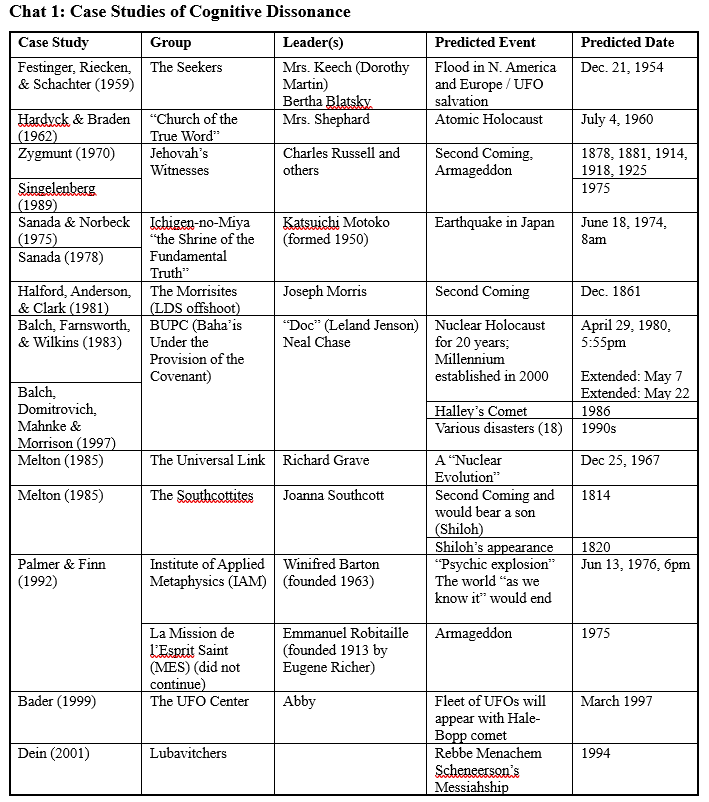
Hardyck and Braden (1962) looked at “the Church of the True Word” whose prophet predicted a nuclear holocaust on July 4, 1960. After building fallout shelters and remaining in them for weeks, the group emerged without the atomic bomb having dropped. They rationalized away this failed prediction, and continued as a group. Yet they did not proselytize.
Zygmunt (1970) and Singelenberg (1989) looked at the Jehovah’s Witnesses movement that had various predictions of Armageddon that never transpired (1878, 1881, 1914, 1918, 1925, 1975), after which the leadership provided varying rationalizing responses. The group remains to this day and still awaits Armageddon, though they’ve given up an exact date.
Balch et al (1981, 1983) focused on the Bahai’s Under the Provision of the Covenant (BUPC) – an apocalyptic subgroup of the Bahai faith. When the nuclear holocaust that their leader “Doc” predicted failed to transpire on April 29, 1980, the group has survived to this day by redirecting focus away from the failed prophecy and placing emphasis on the larger Baha’i theology. They thus turned to a greater “nexus of belief” to sustain their group past disconfirmation. They did not turn to proselytization.
There are various other groups studied (see the chart). The Japanese “Ichigen-no-Miya” group predicted a massive 1974 earthquake in Japan, and when that prediction failed, they spiritualized their leader’s attempted suicide claiming that he had embodied the cataclysm in his own flesh and his suicide attempt averted the disaster (Sanada & Norbeck, 1975). The early LDS-offshoot known as the Morrisites remained committed after the 1861 second coming never occurred for a variety of reasons (Halford et al, 1981). The Institute of Applied Metaphysics (IAM) spiritualized the failed 1976 “psychic explosion” as an increased power of love in the world (Palmer & Finn, 1992). The Lubavitchers continued to believe their Rabbi was their predicted Messiah even after his sudden death in 1994, rationalizing his death away claiming he was now more spiritually present in the earth than he ever could have been physically (Dein, 2001). Other studies include “the Universal Link” (Melton, 1985), the Southcotties (Melton, 1985) and the UFO Center (Bader, 1999).
Adaptational Strategies
From these studies, we can pull out three broad “adaptational strategies” used by groups to mitigate cognitive dissonance in the wake of a prophetic non-event.
- Proselytization. Though not as common as Festinger et al believed, this does remain a rare means of lessening cognitive dissonance and maintaining group cohesion.
- Rationalization. Rationalization can occur in a variety of ways:
- The was an error in dating; the group continues to push the date ahead into the future.
- The group blames either members or non-members (including malevolent spiritual entities). In the former case, the group experiences repentance and purging; in the latter case, the group perpetuates what Zygmunt called “conspiratorial doctrines” (Zygmunt 972, 262).
- The prediction was a test of faith
- The group rationalizes through spiritualization; in this way, an empirical failure becomes an unfalsifiable claim of success because a spiritualized fulfillment can’t be disconfirmed.
- A shift in focus towards a greater “nexus of belief” is seen most notably among Jehovah’s Witnesses and the Bahai’s Under the Provision of the Covenant (BUPC).
- The non-event is seen as a providential benefit for the world, often giving the world time for repentance
- Reaffirmation. Leadership quickly reaffirms the group’s identity through various means.
Social Factors
In addition to these adaptational strategies, there are also social factors that can affect whether a group remains intact beyond a prophetic non-event.
- Decisive Leadership. The speedy response of leaders to help their communities rationalize the non-event and reaffirm the group identity is crucial in whether groups survive
- Cost of leaving. Different results are seen depending on whether the commitment has been high among members and the cost of leaving outweighs the work of mitigating cognitive dissonance.
- Identity change and Institutionalization. Seen most clearly among Jehovah’s Witnesses, forming an institution helps mitigate the effects of prophetic failure
PART TWO: Dissonance in the Early Christian Movement
With this ground work laid, I then sought to first answer question of whether the early Christian movement indeed fits Festinger’s Five Conditions. I argue it does, but not as strongly as we’d like due to the highly diverse and geographically spread-out nature of the early Christ groups. Remember, the focus of my essay was on belief in the future Parousia (coming) of Christ within Jesus’ own generation, as he himself predicted (Mark 13:29-30). I think this saying of Jesus is authentic and comes from him.
Below is a review of Festinter’s Five Conditions:
- The belief must be held with deep conviction
- The person must have committed him/herself to it in action
- The belief must be sufficiently specific and concerned with the real world
- There must be undeniable disconfirmatory evidence that is recognized
- The individual must have social support (i.e. a group phenomenon)
I argue in the essay that condition 1 (conviction of belief) is evident in the New Testament literature.
Condition 2 (commitment in action) was more difficult to assess with consistency due to the diversity of early Christianity. The early Jewish Christian community in Judea gave away all possessions and lived in fiscally-dependent communities (Acts 2:44-45; 4:34-35). This is similar to the Qumran sect (1QS 1.11-55) and in direct continuity with Jesus’ own end-times focused act of giving away all possessions (Mark 10:21; Matt 6:19-20; Luke 12:33). Pauline Christians did not share this end-times practice of imposed poverty and communal finances. This means different Christ groups likely exhibited various levels of commitment in action, meaking this condition difficult to apply to early Christianity across the board.
Condition 3 (sufficiently specific prediction) and condition 4 (disconfirmatory evidence) work together. The tradition claims Jesus gave a specific time marker for the parousia—“this generation” (Mark 13:29-30), confirmed in other likely authentic Jesus sayings (Mark 9:1; Matt 10:23). I agree with Ehrman: “Jesus maintained that his new kingdom was coming soon, that in fact his own generation would see it” (Ehrman 1999, 21). I personally find the argument that Jesus viewed the historical fall of Jerusalem in 70 AD as the “coming of the Son of Man” (see Wright 1996, 339-368) as ultimately unconvincing. Jesus seemed to clearly expect not just the end of Jerusalem, but the end of history in his generation. This specific expectations of the end of the world in the near future was carried over into the early Christian communities: “the God of peace will shortly crush Satan under your feet” (Rom 16:20), “the present form of this world is passing away” (1 Cor 7:31), and “the Lord is near” (Phil 4:5; Heb 10:25; James 5:9; 1 Peter 4:7) and “coming soon” (Rev 22:7; 12, 20). This prediction was “sufficiently specific” (as condition 3 requires) and early Christ groups recognized the disconfirmatory evidence of the parousia’s non-event (condition 4). Condition 4 is seen most clearly in 2 Peter 3:
…[Scoffers] will say, “Where is the promise of his coming? For ever since the fathers fell asleep, all things are continuing as they were from the beginning of creation” … But do not overlook this one fact, beloved, that with the Lord one day is as a thousand years, and a thousand years as one day. The Lord is not slow to fulfill his promise as some count slowness, but is patient toward you, not wishing that any should perish, but that all should reach repentance. (2 Peter 3:3-4, 8-9a)
2 Peter demonstrates that not only did insider Christians recognize the prophetic non-event, but even outsiders (the “scoffers”) did as well. Condition 3 and condition 4 are met. (Other evidence is given in the paper but his is satisfactory for a summary.)
Condition 5 (social support) is uncontroversial in regards to early Christ groups.
It appears that, generally speaking, early Christ groups fit Festinger’s Five Conditions and thus should be able to be studied as millenarian groups that needed to mitigate cognitive dissonance in order to survive past prophetic a non-event. Early Christianity succeeded in this. I finished the essay with three features of early Christianity that I argued allowed this.
(i) Preexistent Dissonance Reduction Tools within Second Temple Judaism
Working off the brilliant work of Robert Carroll (“When Prophecy Failed: Reactions and Responses to Failure in the Old Testament Prophetic Traditions,” 1979), I argue that the biblical prophets and the Jews of the second temple period had already developed an expansive set of tools to rationalize failed prophecy throughout their history. The early Christian groups inherited these tools already prepared. Carroll demonstrates this dynamic extensively, but his greatest strength in argument regards the various layers of Isaiah (i.e. Second-Isaiah and Trito-Isaiah) (p. 150-155) and the rise of apocalyptic itself as a means of rationalizing the failure of classical prophecy among later Jewish communities (p. 205). I agree with much of what Carroll wrote. Ultimately, I argue that Second Temple Judaism had already developed long-tested hermeneutical tools to deal with failed prophecy. Early Christ groups simply inherited these same tools.
(ii) Authoritative Text as “Decisive Leadership Guidance”
As stated in part one, millenarian groups need decisive leadership to help guide members through prophetic disconfirmation. Without this, many groups risk failure. I argue this “decisive leadership” was embodied in the production of special authoritative texts for the movement (the New Testament). This centrality of authoritative text was also inherited from Judaism. I demonstrate use of sacred text through three examples. First, the synoptic gospels, second the Pauline tradition, and finally John’s Gospels.
The arguments and evidence I lay out in my essay are too expansive for this summary, but one argument I particularly liked (and haven’t seen anywhere else to my knowledge) regards various Pauline communities. Assuming scholarly conclusions on the six “pseudo-Pauline letters” (i.e. not written by Paul but after his death in his name): 2 Thessalonians, Ephesians-Colossians, and the pastorals (1 Tim, 2 Tim, Titus), we can see an interesting trend. Different pseudo-Pauline texts seem to represent different communities of the second and third generations rationalizing the parousia’s non-event in different ways: 2 Thessalonians rationalizes through “error of dating” (2 Thess 2); the letters of Ephesians and Colossians represent leadership “shifting focus” away from the near second coming to a greater “nexus of belief” with developed theology; and the Pastoral epistles (1 Tim, 2 Tim and Titus) lean into institutionalization as a means of mitigating dissonance and preserving the apocalyptic Christian movement past its apocalyptic non-event within the institutional church, the “pillar and buttress of the truth” (1 Tim 3:15).
While this particular argument holds necessary assumptions, I found it at least interesting to argue and potentially insightful in mapping out various Pauline communities that uniquely navigated the parousia’s non-event after Paul’s death.
(iii) The Resurrection of Christ: A Greater “Nexus of Belief”
I finish the essay with how the early Christian movement doesn’t quite fit the various studies cognitive dissonance studies we’ve looked at perfectly because of one major factor: belief in the past resurrection of Christ. The early Christian movement was never founded exclusively on belief in the future coming of the Son of Man in that generation—it looked back to the past empty tomb and resurrection. This rooted future hope in the historical past. Even if Jesus was wrong about the coming of the Son of Man, the movement he started believed in his past resurrection, which acted to mitigate a bulk of cognitive dissonance in the wake of a prophetic non-event. I state in my essay, “As inconvenient as it might be, belief in the past resurrection of Jesus does appear to throw a proverbial wrench in our work of clear comparison. Despite its promise, the greatest weakness in the usefulness of Festinger et al. upon the study of early Christianity is the story of the empty tomb.”
Conclusion
Ultimately, I conclude Festinger et al does seem to be correct. “…when people are committed to a belief and a course of action, clear disconfirming evidence may simply result in deepened conviction and increased proselytizing” (Festinger et al., p. 12). And I argue this can be seen generally speaking within early Christianity.
While the complete overlap between early Christianity with these other modern millenarian groups isn’t perfect, I conclude the general overlap and findings of Festinger et al (and subsequent scholars) do provide insight into the endurance of early Christianity after the Son of Man never came. I found it particularly insightful with the pseudo-Pauline texts. The analysis also highlighted the tremendous benefit that early Christianity had in being a second temple Jewish group, inheriting already worked-out tools of dissonance reduction and an emphasis on authoritative text to guide the community in the wake of cognitive dissonance.
If new frameworks are in anyway helpful, they must be helpful in bringing more clarity and insight, not less. I think fifty years of cognitive dissonance research has done just that.
Works Referenced:
Bader, Chris. “When Prophecy Passes Unnoticed: New Perspectives on Failed Prophecy.” Journal for the Scientific Study of Relgion, Vol. 38, No. 1 (March 1999): 119-131.
Balch, Robert W., John Domitrovich, Barbara Lynn Mahnke, and Vanessa Morrison. “Fifteen Years of Failed Prophecy: Coping with Cognitive Dissonance in a Baha’i Sect.” In Millennium, Messiahs, and Mayhem: Contemporary Apocalyptic Movements, edited by Thomas Robbins and Susan J. Palmer, 73-90. New York: Routledge, 1997.
Balch, Robert W, Gwen Farnsworth and Sue Wilkins. “When the Bombs Drop: Reactions to Disconfirmed Prophecy in a Millennial Sect.” Sociological Perspectives, Vol. 26, No. 2 (April 1983): 137-158.
Dawson, Lorne L. “When Prophecy Fails and Faith Persists: A Theoretical Overview.” Nova Religion: The Journal of Alternative and Emergent Religions, Vol. 3, No. 1 (October 1999): 60-82.
Dein, Simon. “What Really Happens When Prophecy Fails: The Case of Lubavitch.” Sociology of Religion, Vol. 62, No. 3 (Autumn 2001): 383-401.
Ehrman, Bart D. Jesus: Apocalyptic Prophet of the New Millennium. Oxford University Press, 1999. Kindle Edition.
Festinger, Leon, Henry W. Riecken and Stanley Schachter. When Prophecy Fails. Minneapolis: University of Minnesota Press, 1956.
Halford, Larry J., C. Leory Anderson, and Robert E. Clark. “Prophecy fails again and again: The Morrisites.” Free Inquiry in Creative Sociology, Vol. 9, No. 1 (1981): 5-10.
Hardyck, Jane Allyn and Marcia Braden. “Prophecy Fails Again: A Report of a Failure to Replicate.” Journal of Abnormal and Social Psychology, Vol. 65, No. 2 (1962): 136-141.
Melton, J. Gordon. “Spiritualization and Reaffirmation: What Really Happens When Prophecy Fails.” American Studies, Vol 26, No. 2 (Autumn 1985): 17-29
Palmer, Susan J., and Natalie Finn. “Coping with Apocalypse in Canada: Experiences of Endtime in la Mission de l’Esprit Saint and the Institute of Applied Metaphysics.” Sociological Analysis 53, no. 4, (Winter 1992): 397-415.
Sanada, Takaaki. “After Prophecy Fails: A Reappraisal of a Japanese Case.” Japanese Journal of Religious Studies, Vol. 6, No. 1/2. (March-June, 1978): 217-237.
Sanada, Takaaki, and Edward Norbeck. “Prophecy Continues to Fail: A Japanese Sect.” Journal of Cross-Cultural Psychology, Vol. 6, No. 3. (September 1975): 259-383.
Singelenberg, Richard. “‘It Separated the Wheat from the Chaff’: The “1975” Prophecy and Its Impact among Dutch Jehovah’s Witnesses.” Sociological Analysis 50, no. 1 (Spring 1989): 23-40.
Wright, N.T. Jesus and the Victory of God: Christian Origins and the Question of God, Vol 2. Minneapolis, Fortress Press, 1996.
Zygmunt, Joseph F. “Prophetic Failure and Chiliastic Identity: The Case of Jehovah’s Witnesses.” American Journal of Sociology, Vol. 75, No. 6 (May 1970): 926-948.
Zygmunt, Joseph F. “When Prophecies Fail: A Theoretical Perspective on the Comparative Evidence.” The American Behavioral Scientist, Vol. 16, No. 2 (November 1972): 245-268.
 Theological Musings of a Thirty-Something
Leave a comment